In 1964, science fiction writer Arthur C. Clarke predicted that computers would overtake human evolution.“Present-day electronic brains are complete morons, but this will not be true in another generation,” he told the BBC. “They will start to think, and eventually, they will completely out-think their makers.”
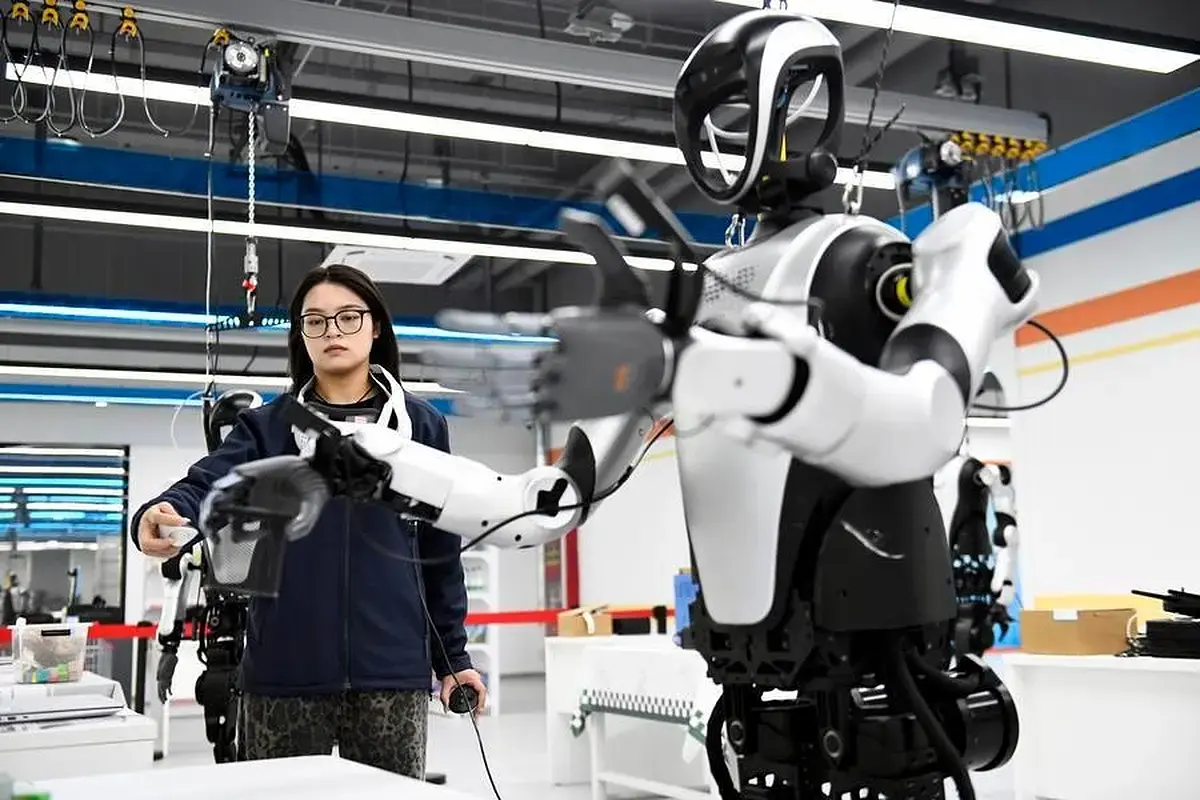
Daniel Roher opens his new documentary The AI Doc: Or How I Became An Apocaloptimist (2026) with this cheerful prophecy. And in the hundred-some minutes that follow, he tries to make sense of a technology that, by his own admission, he does not understand — and a world that is rapidly being changed by it. Explaining that he conceives of AI as a “magic box floating in space,” he enlists the help of experts to provide him with a crash course in what, exactly, AI is.
Roher’s real concern, however, isn’t so much about the workings of AI — though some of his subjects do attempt to explain them for him — but whether it might displace us, as Clarke’s prediction suggests it will.
While making the film, Roher learns that his wife Caroline is pregnant with their first child. He tracks his wife’s pregnancy and the birth of his son in parallel with the advent of AI. It’s a smart choice that builds on a fear all parents share: What sort of world are we making for our children? And behind that question is another, vibrating in anxious silence: What happens after our offspring replace us? This twinned existential angst drives his efforts to hear from the doomers, the techno-optimists, and the in-between “apocaloptimists” whose ranks he ultimately joins.
The AI Doc, as its sweeping title suggests, wants to shape and lead the narrative around AI. It’s certainly set up to do that — Roher is fresh off an Oscar win for his documentary Navalny, and the film opened in nearly 800 theaters, which counts as wide-release for a nonfiction title. The final product is indicative of the ways that public attitudes around AI are in massive flux. Roher hopes to reach people of my grandmother’s generation who conflate AI with smartphones and spellcheck, as well as people who don’t seem to care whether a video was AI-generated.
But I think that this documentary has come too late to steer the conversation, something the film itself acknowledges. For all its transformative potential, AI isn’t actually unique among emerging technologies yet — it has not been cataclysmic or ushered in a golden age of prosperity — but Roher and many of those he interviews tend to treat it as a radical break with all that has come before. As a result, they tend to fixate on the binary extremes of doom or salvation. It’s an approach that reinforces our own helplessness in the face of AI-driven change, while also muddying our understanding of what we might yet be able to do as we seek to adapt, mitigate harm, and shape the world that AI could otherwise truly start remaking.
Roher, contemplating his child’s future, opts to hear the bad news first. Tristan Harris, the cofounder of the Center for Humane Technology, doesn’t mince words: “I know people who work on AI risk who don’t expect their children to make it to high school.”
Many of the film’s other interviewees are similarly gloomy. Geoffrey Hinton, the “godfather of AI,” for example, argues that as AI becomes smarter, it will become better at manipulating humanity. But no one is more pessimistic than Eliezer Yudkowsky, the well-known AI doomer and co-author of the controversial book If Anyone Builds It, Everyone Dies. As the title suggests, Yudkowsky believes that superintelligent AI would wipe out humanity — a position that he stands by and lays out for Roher.
Turning his back on these storm clouds — and taking the advice of his wife, Caroline, who tells him that he needs to find hope for the future — Roher tunes into the chorus of AI optimists. They tell him, variously, that there are more potential benefits than downsides to AI; that technology has made the world better in every way; that this will be the tool that helps us solve all our greatest problems. Not to mention: AI will bring the best health care on the planet to the poorest people on Earth, extend our healthspan by decades, and enable us to live in a postscarcity utopia free of drudgery. Oh, and: We will become an interplanetary species, all thanks to AI.
These promises initially reassure Roher, perhaps because he seems easily led by whomever he’s spoken to most recently. It is Harris who ultimately convinces him that we can’t separate the promise of AI from the peril it presents. The conclusions that result will be obvious to anyone who’s thought about these issues for more than a moment or two: If AI automates work, for example, how will people make a living?
It doesn’t help that many of the most invested players reflect on these questions superficially, if at all. OpenAI CEO Sam Altman tells Roher that he’s worried about how authoritarian governments will use AI — a claim that is followed in the film by a cut to images of Altman posing with authoritarian leaders. Other tech CEOs fall back on PR pleasantries in response to the filmmaker’s questions, and Roher too often goes easy on them, never diving deeper when they admit that even they aren’t confident that everything will go well. That these are the leaders of AI companies racing against each other to make the technology more and more advanced does little to inspire confidence.
(Some of the techno-pessimistic people interviewed for the documentary have expressed their strong displeasure with the final result.)
“Why can’t we just stop?” Roher asks these tech CEOs. He’s told that a moratorium is a pipe dream: Many groups around the world are building advanced AI, all with different motivations. Legislation lags far behind the rate of technological progress. Even if we could pass laws in the US and EU that would stop or slow things down, says Anthropic CEO Dario Amodei, we’d have to convince the Chinese government to follow suit.
If we don’t create it, the thinking goes, our enemies will. It’s best to get ahead of them.
This is, of course, the logic of nuclear deterrence: If we don’t mitigate the risk of ending the world through mutually assured destruction, there’s nothing stopping someone else from pressing the button first.
An apocalypse in every generation
The atomic comparison is apt, if only because Roher sees the stakes in similarly stark terms. “Will my son live in a utopia, or will we go extinct in 10 years?” he wonders aloud. It’s a question that’s central to the film. But he never really sits with the more likely scenario that AI will neither lead to human extinction nor end all disease and drudgery. Every generation faces the specter of its own annihilation — and yet the ends of days keep accumulating, no matter how close the doomsday clock gets to apocalypse.
The point, then, isn’t that AI won’t be bad for us, but that by framing the question in strictly utopian or dystopian terms, we miss the messy reality that lies between hell on earth and heaven in the stars. Although The AI Doc tries to chart an “apocaloptimist” course between two extremes, it doesn’t grasp the real stakes. AI doesn’t really create new risks as such — it’s a force multiplier for existing ones like the threat of nuclear warfare and the development and use of biological weapons. The chief existential risks of AI are human-made and human-driven. And that means, as Caroline says in the film’s ending narration, “We get to decide how this goes.” She’s right, but her husband never seems to understand how she’s right.
Like too many Big Issue Documentaries, Roher’s film is heavy on problems and light on solutions. It does offer some, calling for international cooperation, transparency, legal liabilities for companies if something goes wrong, testing before release, and adaptive rules to match the speed of progress. But just as this is a strictly introductory course in AI — one that will probably irritate those who’ve already moved on to AI 102 — these recommendations are only a starting point. For Roher, they offer reason to be hopeful. For the rest of us, they’re just the beginning of an opportunity to meaningfully steer the course of our future.